
The 50/30/20 rule is the simplest budget there is: half your pay on things you must pay, 30% on things you choose, and 20% for your future. The catch in the UK is housing. With average rent at £1,406 a month, the "50% needs" bucket is blown on rent alone for anyone earning under about £41,000 who lives alone. Here's how the rule works on real 2026/27 take-home pay, who it suits, and what to do if your numbers don't fit.
Foundations
50/30/20 Rule UK: Does It Work on a UK Salary?
The 50/30/20 rule UK guide for 2026/27: real take-home figures, why rent breaks the 50% for many, and splits that actually work.
In this article
Key takeaways
- The split: 50% needs, 30% wants, 20% savings and extra debt repayments, always worked out on take-home pay, not salary.
- On £30,000: take-home is about £2,093 a month in England, Wales and Northern Ireland in 2026/27, so the rule gives £1,047 / £628 / £419.
- Rent is the problem: the average UK private rent was £1,406 a month in September 2026 (ONS), which is 67% of take-home pay on £30,000 and 51% at the median full-time salary of £40,911.
- Couples fare better: two people on £30,000 sharing an average rent, energy, council tax and food bill spend about 48% of joint take-home on those basics.
- Adapt, don't abandon: if needs take more than half, shrink wants first and keep saving something, even if it's 10% rather than 20%.
If you'd rather not juggle percentages on a calculator, the UK Budget Planner does the split for you from your real take-home pay and tracks it month by month.
What is the 50/30/20 rule?
The 50/30/20 rule is a budgeting method that divides your monthly take-home pay into three buckets: 50% for needs, 30% for wants and 20% for savings and debt. It was popularised by US senator Elizabeth Warren and her daughter Amelia Warren Tyagi in their 2005 book All Your Worth, and it's the starting point recommended in our complete guide to budgeting in the UK.
| Bucket | Share | What goes in it (UK examples) |
|---|---|---|
| Needs | 50% | Rent or mortgage, council tax, energy, water, food shopping, travel to work, phone and broadband, insurance, minimum debt payments, childcare |
| Wants | 30% | Eating out, takeaways, streaming, gym, holidays, clothes beyond the basics, hobbies, gifts |
| Savings and debt | 20% | Emergency fund, ISA or pension top-ups, a house deposit, paying debts off faster than the minimum |
The appeal is that you only need three numbers. You don't have to track every coffee, as long as each bucket stays within its limit.
Take Action: Before anything else, check the figure that actually lands in your account each month. That's the number the rule applies to.
How does the 50/30/20 rule work on a UK salary?
Apply the percentages to your take-home pay after Income Tax and National Insurance. For 2026/27, GOV.UK sets the Personal Allowance at £12,570 with 20% basic-rate tax on the next £37,700, and employee National Insurance is 8% between £242 and £967 a week, then 2% above that.
Here's what that means across typical salaries in England, Wales and Northern Ireland. The figures ignore pension contributions and student loan repayments, which would lower take-home pay further.
| Salary | Monthly take-home (approx.) | Needs (50%) | Wants (30%) | Savings and debt (20%) |
|---|---|---|---|---|
| £25,000 | £1,793 | £897 | £538 | £359 |
| £30,000 | £2,093 | £1,047 | £628 | £419 |
| £35,000 | £2,393 | £1,197 | £718 | £479 |
| £40,911 (median full-time) | £2,748 | £1,374 | £824 | £550 |
| £50,000 | £3,293 | £1,647 | £988 | £659 |
The £40,911 row is the ONS's median gross annual pay for full-time employees who had been in their job for at least a year, in April 2026, up 4.5% on a year earlier. For a full monthly plan on one common salary, see how to budget on £30,000. If you live in Scotland, your Income Tax bands are different, so your take-home pay will be slightly different too.
To run the split on your own pay, including pension and student loan deductions, use the free UK budget calculator.
Does the 50/30/20 rule work in the UK?
The 50/30/20 rule works in the UK for many couples, homeowners with older mortgages and people earning above the median, but it often doesn't work for single renters. The reason is housing costs, which have risen much faster than the rule's 50% assumes.
The ONS reported on 21 October 2026 that the average UK private rent reached £1,406 a month in September 2026, up 3.8% in a year. In England it was £1,466 and in London £2,338. Compare that with take-home pay:
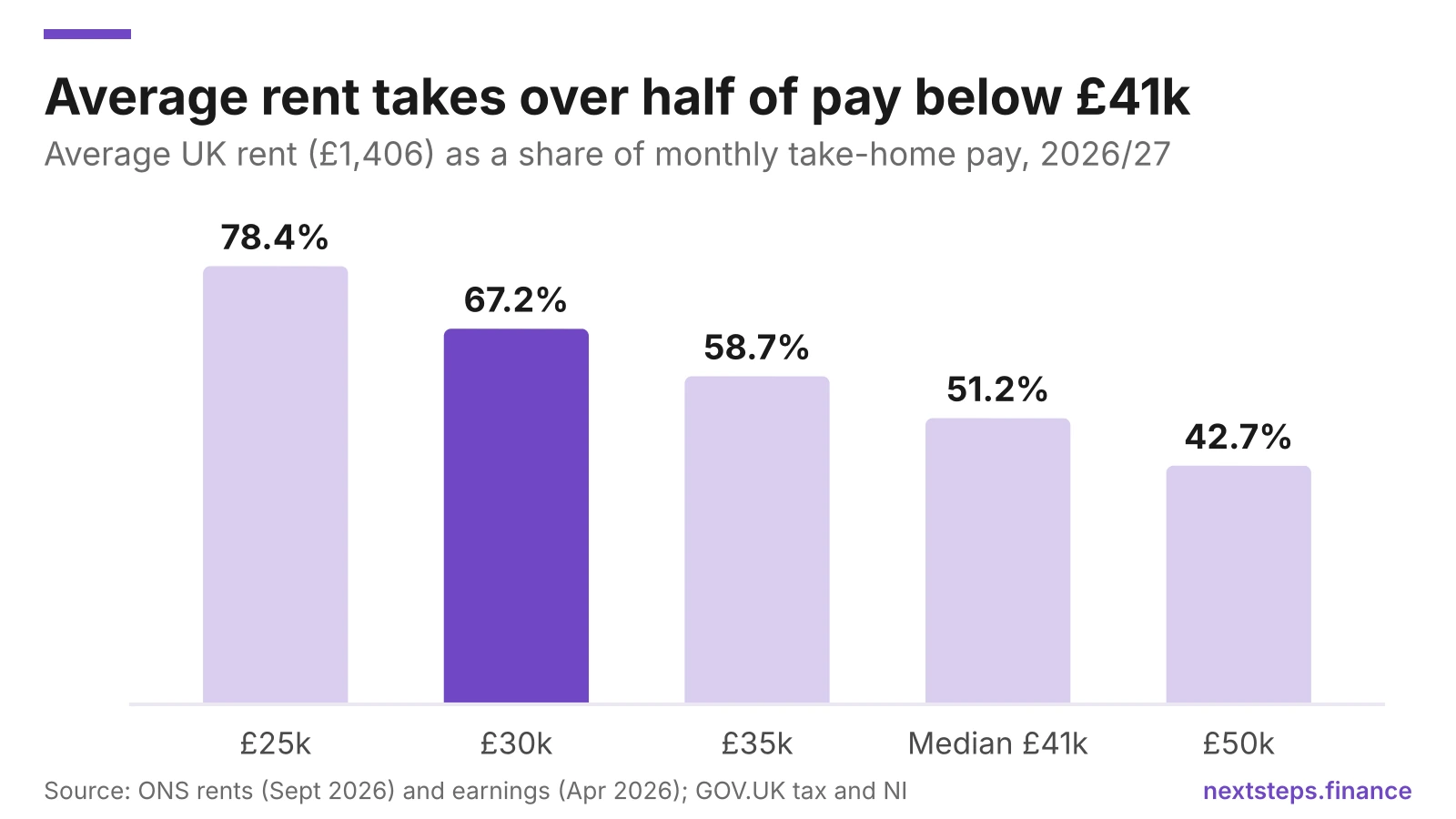
On £30,000, average rent alone is 67% of take-home pay, before you've paid for food or heating. Only at the median salary and above does rent come close to fitting inside the needs bucket, and even then there's nothing left for the other essentials.
A single renter on £30,000
Here's a realistic needs bucket for one person on £30,000 renting at the UK average:
| Need | Monthly cost | Source |
|---|---|---|
| Rent | £1,406 | ONS average UK rent, Sept 2026 |
| Food and drink at home | £146 | DEFRA Family Food: £33.63 per person per week |
| Energy | £144 | Ofgem cap of £1,723 a year, Oct-Dec 2026 |
| Council tax (25% single person discount) | £117 | England average £1,868 per dwelling, MHCLG 2026-27 |
| Total | £1,812 | 87% of £2,093 take-home |
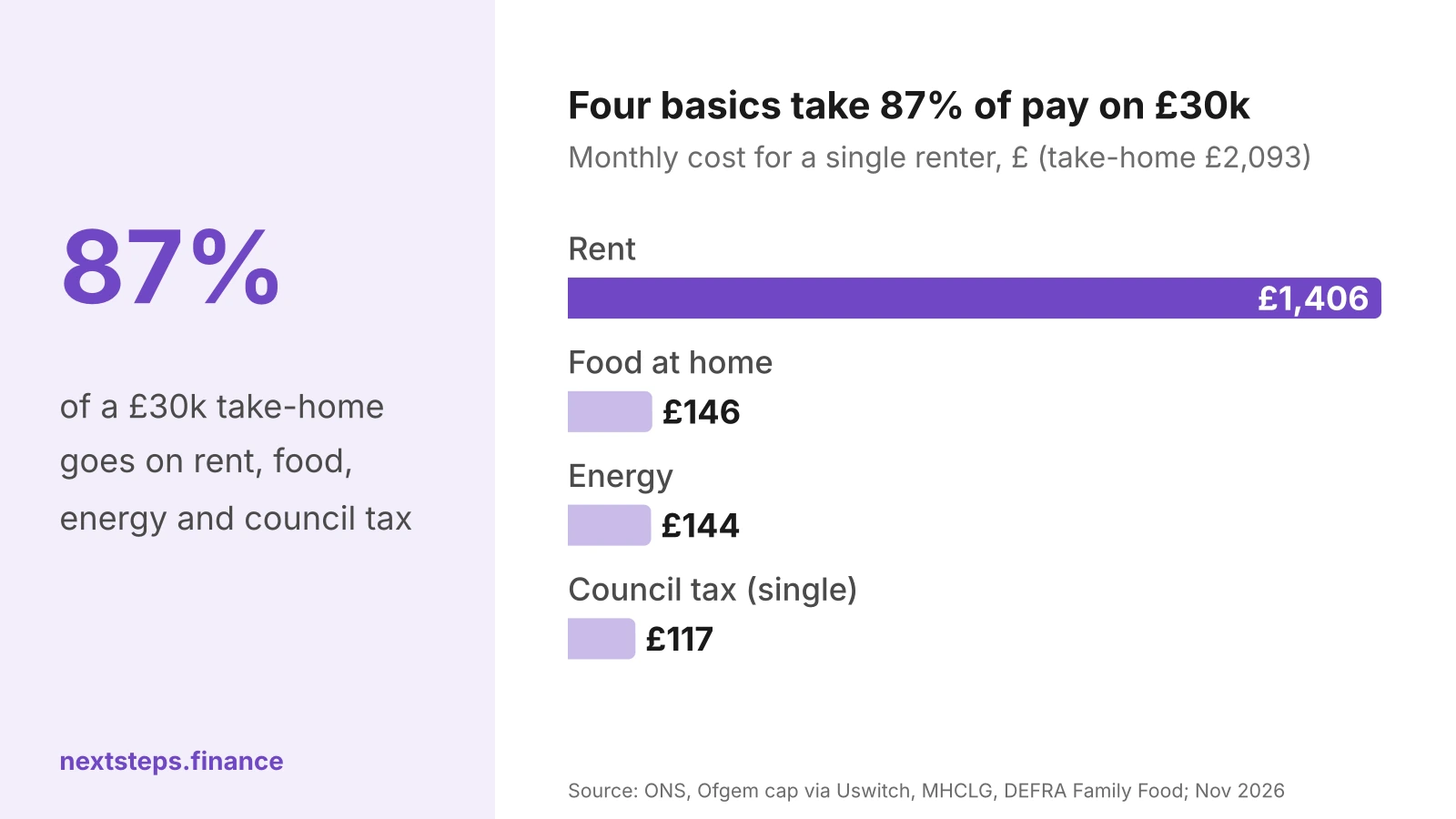
That's before travel, phone, broadband, water and insurance. For this person, a 50/30/20 split simply isn't possible. Most people in this position share a home, rent a room or live somewhere cheaper: average rent was £1,011 in Scotland, £848 in Wales and £879 in Northern Ireland.
A couple on £30,000 each
Put two £30,000 earners in the same average-rent home and the picture flips. Their joint take-home is about £4,187 a month. Rent, energy, full council tax and food for two come to about £1,997, or 48%. The rule fits, with room for travel and bills inside a bucket that's still close to 50%.
Take Action: Add up your own needs from last month's bank statement. If they're under 50% of take-home pay, the rule will work for you as it is. If not, read on.
What if my needs are more than 50%?
If your needs take more than 50% of your take-home pay, change the split rather than giving up on the method. Keep the structure (needs, wants, savings) and adjust the percentages until they match your real costs.
Common UK alternatives:
| Split | Who it suits |
|---|---|
| 60/20/20 | Renters and parents in higher-cost areas who still want to save 20% |
| 70/20/10 | Single renters or anyone paying for childcare, where needs are unavoidable |
| 70/10/20 | People building an emergency fund or clearing expensive debt, who can cut wants hard for a while |
| 80/10/10 | A short-term emergency budget, for example after a job loss or a big rise in bills |
Three rules of thumb help when you adjust:
- Cut wants before savings. Even 5-10% saved builds an emergency fund over time, and having one stops a broken boiler becoming credit card debt.
- Attack the biggest need, not the small ones. Rent, mortgage, car finance and energy matter more than switching your phone contract (though do that too). Check whether you're paying more than you need to on energy before the January 2027 price cap change.
- Revisit it when your pay changes. A pay rise is the easiest time to move closer to 50/30/20, because you can send most of the increase to savings before you get used to spending it.
Take Action: Pick the split that's closest to your real numbers today and write it down. Plan to move it one step closer to 50/30/20 at your next pay rise.
What counts as a need or a want?
A need is a cost you must pay to live, work and stay out of trouble with creditors. A want is anything you could stop tomorrow without serious consequences. The grey areas are where most budgets go wrong.
- Food: the supermarket shop is a need; takeaways, meal deals and eating out are wants. DEFRA's data shows the average person spent £12.69 a week eating out (including alcohol) on top of £33.63 on food at home.
- Phone and broadband: a basic contract is a need; the latest handset on a £60-a-month plan is partly a want.
- Car: getting to work is a need, but the size of the finance payment may not be.
- Debt: minimum payments are a need. Anything extra goes in the 20% bucket.
- Subscriptions: almost always wants, even the ones you've had for years.
Be honest when you label things. The rule only works if "needs" isn't quietly hiding wants.
How do I set up the 50/30/20 rule?
The easiest way to run 50/30/20 is to split your pay into separate pots on payday, so each bucket has its own balance and you can see what's left at a glance.
- Work out your monthly take-home pay from your payslip, or use the UK budget calculator.
- List your needs from your last three months of bank statements and total them.
- Choose your split: 50/30/20 if needs fit, or one of the alternatives above.
- Set up three pots or accounts: bills and needs, spending money, and savings.
- Move the money on payday before you spend anything, then spend only from the "wants" pot.
- Review monthly and adjust if a bucket keeps running short.
A free budget template works fine for steps 1 to 3. For steps 4 and 5, a bank with built-in pots does most of the work.
Using Monzo pots for 50/30/20
Monzo suits the 50/30/20 method well because you can create up to 20 Pots, pay direct debits from a bills pot, and lock or hide a savings pot so you're not tempted to dip in. Its Salary Sorter prompts you to split your salary between pots when it lands, and remembers the amounts for next month. If you're paid by Bacs, you can also get your salary from 4pm one working day early.
Under Monzo's current referral terms, a new customer aged 18+ who joins through a friend's link gets £10 and a free month of Monzo Extra after applying, adding money and making a card payment within 30 days. Extra is a paid plan after the free month, so cancel it if you don't want it. Eligible money is protected by the FSCS up to £120,000 per person.
The downsides: regular pots don't earn interest (Monzo's separate Savings Pots do, at rates that depend on your plan), and you'll still need to check that your savings pot rate is competitive. If you'd rather keep your current bank, a budgeting app such as Emma can pull your accounts into one view so you can see your spending by category. Emma has a free plan, with paid plans for extra features. Our best budgeting apps UK round-up compares the main options.
| Option | Best for | Key point |
|---|---|---|
| Monzo pots | Splitting pay on payday | Up to 20 pots, Salary Sorter, £10 + free month of Extra via referral |
| Emma | Tracking spending across several banks | Free plan; one view of spending across your accounts |
| Spreadsheet or budget template | People who like control | Free, but you update it yourself |
| UK Budget Planner | A full-year plan with sinking funds | Built for UK pay, tax and bills |
Take Action: Set up three pots (needs, wants, savings) before your next payday and move the money the day it arrives.
Is 20% the right amount to save?
Twenty per cent is a good long-term target, but the right amount depends on what you're saving for and whether you have expensive debt. Your first priority should usually be a small emergency fund, then clearing any debt costing more than your savings earn, then longer-term goals.
Pension contributions taken from your salary count towards your savings, even though they never reach your bank account. If you pay 5% into a workplace pension, you might only need another 15% from take-home pay to hit a 20% savings rate overall. Christmas is a good test of the 20% bucket too: if you build a Christmas budget into your savings plan through the year, December stops being a shock.
With inflation expected to rise, money left in an account paying little or no interest loses value. Once your emergency fund is in place, make sure it earns a competitive rate. Our guide to savings rates after the rate rise shows where to look.
FAQ
What is the 50/30/20 rule in the UK?
The 50/30/20 rule is a budgeting method that splits your take-home pay into three parts: 50% for needs such as rent, bills and food, 30% for wants such as eating out and holidays, and 20% for savings and extra debt repayments. In the UK, apply it to pay after Income Tax, National Insurance and pension deductions.
How much is 50/30/20 on £30,000 a year?
On a £30,000 salary in England, Wales or Northern Ireland, take-home pay in 2026/27 is about £2,093 a month, ignoring pension and student loan deductions. The 50/30/20 rule gives roughly £1,047 for needs, £628 for wants and £419 for savings and debt. With the average UK rent at £1,406, many single renters will need a different split.
Is the 50/30/20 rule realistic in the UK?
It's realistic for couples, homeowners and people earning above the median salary, but often not for single renters. ONS figures show average UK rent of £1,406 a month in September 2026, which is 67% of take-home pay on £30,000. Many people use 60/20/20 or 70/20/10 instead and keep the same three-bucket structure.
Does rent count as a need in the 50/30/20 rule?
Yes, rent or mortgage payments are needs, along with council tax, energy, water, the food shop, travel to work and minimum debt payments. If your rent alone is more than half your take-home pay, the 50% needs bucket won't fit, so shift to a higher needs percentage and cut wants rather than savings where you can.
Do pension contributions count in the 50/30/20 rule?
Pension contributions taken from your salary reduce your take-home pay, so they sit outside the split if you apply it to what reaches your bank account. They are still savings. If you already pay 5% into a workplace pension, you could aim to save another 15% of take-home pay to reach roughly 20% overall.
What is a better budget rule than 50/30/20?
There's no single better rule; it depends on your costs. Zero-based budgeting gives every pound a job and suits tight budgets, while "pay yourself first" suits people who struggle to save. In expensive areas, a 60/20/20 or 70/20/10 split is a practical alternative. The best budget is the one you'll keep using.
Bottom line
The 50/30/20 rule is a great starting point, but in the UK in 2026 it's a target rather than a rule for many people. Work it out on your real take-home pay, be honest about what counts as a need, and if housing pushes needs past 50%, change the split and keep saving something. Set up separate pots, such as Monzo pots, so the money is divided the day you're paid. If you want the whole year mapped out, with sinking funds for Christmas, car repairs and annual bills, the UK Budget Planner is built for exactly that.
Found this useful? Add Next Steps Finance as a preferred source and Google will show you more of our guides in search and AI answers.
Put this into practice
Build your budget in one sitting
The UK Budget Planner works out your take-home pay, splits it with the 50/30/20 rule, tracks spending through the year and forecasts five years ahead. Made for UK pay, tax and bills.