
NS&I savings rates went up on Thursday 19 November 2026, two weeks after the Bank of England raised Bank Rate to 4%. Four variable accounts rose by 0.20 to 0.25 percentage points, while Premium Bonds were left alone. Here's what changed, what your money would earn, and when NS&I is (and isn't) the best home for your savings.
Stability
NS&I Savings Rates: November 2026 Rise
NS&I savings rates rose on 19 November 2026: Direct Saver now pays 4.00% and Direct ISA 4.05%. See how they compare and who they suit.
In this article
- 01Key takeaways
- 02What are the new NS&I savings rates?
- 03Why did NS&I raise its rates now?
- 04How much will £10,000 earn with NS&I?
- 05Are NS&I savings rates competitive?
- 06Are Premium Bonds worth it after the NS&I rate rise?
- 07Is the NS&I Direct ISA a good cash ISA?
- 08Should you fix with NS&I instead?
- 09Is NS&I safe for large savings?
- 10Bottom line
- 11FAQ
Key takeaways
- NS&I's Direct Saver rose from 3.75% to 4.00% AER and Income Bonds from 3.75% to 4.00% AER on 19 November 2026.
- The NS&I Direct ISA now pays 4.05% tax-free (up from 3.80%) and the Junior ISA 3.90% (up from 3.70%).
- The Premium Bonds prize fund rate is unchanged at 4.35%, with odds of 21,000 to 1 per £1 Bond each month.
- Every penny with NS&I is backed by HM Treasury, with no £120,000 FSCS limit, which matters most if you hold large sums.
- NS&I's fixed-term Guaranteed Growth Bonds pay 4.99% to 5.17% depending on term, from £500.
What are the new NS&I savings rates?
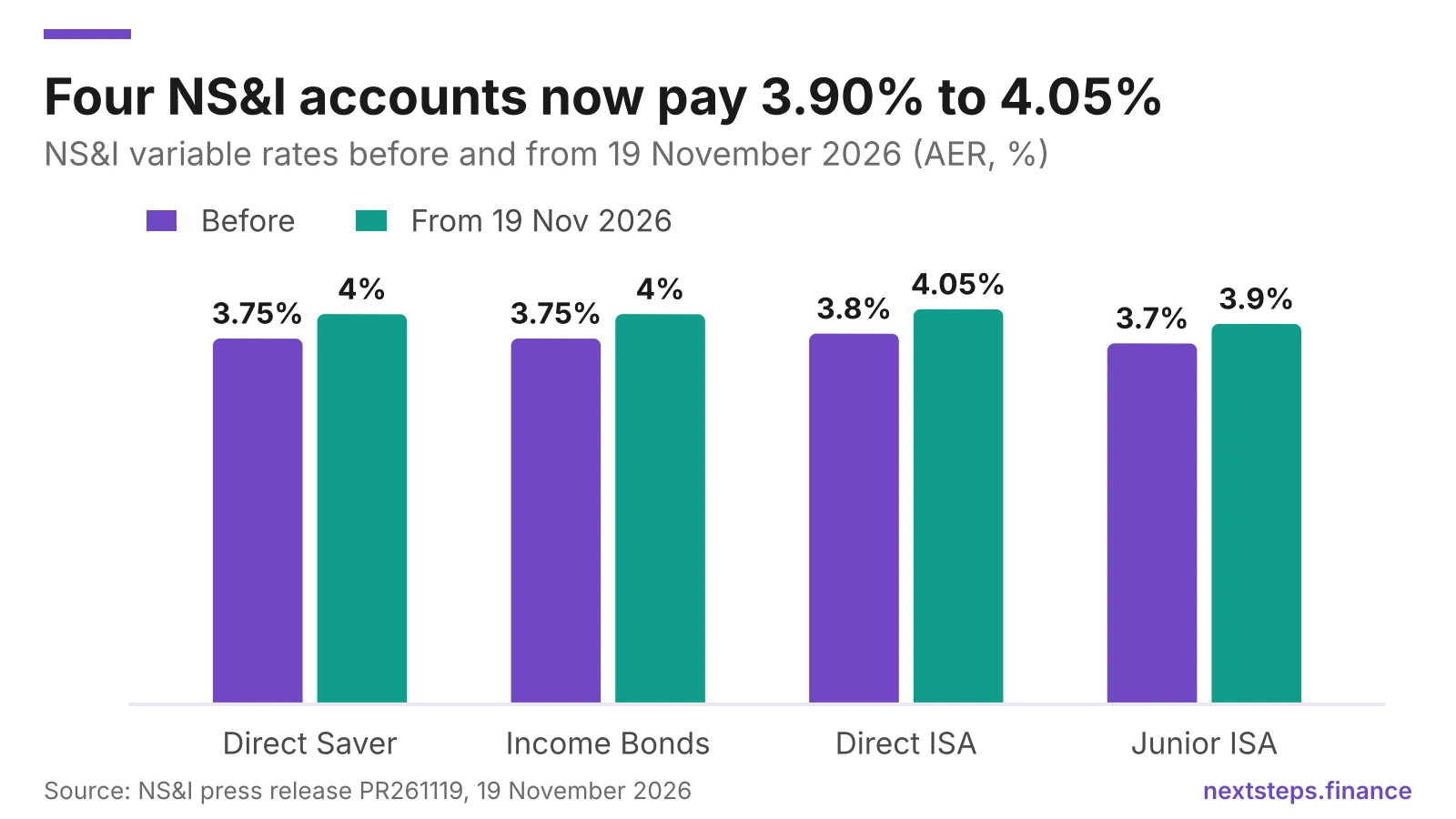
The new NS&I savings rates took effect on 19 November 2026 for both new and existing customers. Four variable accounts went up, according to NS&I's press release:
| NS&I account | Old rate | New rate (from 19 Nov 2026) | Tax |
|---|---|---|---|
| Direct Saver | 3.75% gross/AER | 4.00% gross/AER | Taxable |
| Income Bonds | 3.75% AER (3.69% gross) | 4.00% AER (3.93% gross) | Taxable |
| Direct ISA | 3.80% AER | 4.05% AER | Tax-free |
| Junior ISA | 3.70% AER | 3.90% AER | Tax-free |
| Premium Bonds | 4.35% prize fund rate | 4.35% (unchanged) | Prizes tax-free |
Andrew Westhead, NS&I's Retail Director, said the increases "reflect changes in the wider savings market" and will help NS&I meet its Net Financing target, which is £15 billion (plus or minus £4 billion) for 2026-27. In plain English, the Treasury wants NS&I to bring in a set amount of money this year, so its rates rise and fall to hit that target rather than to top the best-buy tables.
All four rates are variable, so they can fall again. The full list is on the NS&I interest rates page.
Why did NS&I raise its rates now?
NS&I raised its rates because the rest of the market moved first. The Bank of England raised Bank Rate by 0.25 percentage points to 4% on 5 November 2026, its first rise in over three years, and banks have been nudging their savings rates up since. We covered what that rise meant in savings rates after the rate rise to 4%.
Inflation is the other pressure. CPI hit 3.6% in October 2026 (see our October inflation explainer), and the Bank of England expects it to climb towards about 5% by mid-2027. At 4.00%, the Direct Saver is now ahead of today's inflation, but only just. The next Bank Rate decision is due on 17 December 2026.
Take Action: if your savings earn less than 3.6%, they're losing value in real terms. Check your current rate today.
How much will £10,000 earn with NS&I?
£10,000 in the Direct Saver at 4.00% AER earns about £400 a year in interest, £25 more than before the rise. The same sum in the Direct ISA at 4.05% earns about £405, and it stays tax-free.
| Amount saved | Direct Saver (4.00%) | Direct ISA (4.05%) | Extra a year vs old rates |
|---|---|---|---|
| £5,000 | £200 | £202.50 | £12.50 |
| £10,000 | £400 | £405 | £25 |
| £20,000 | £800 | £810 | £50 |
These are one-year figures with interest left in the account. Your result will differ if the variable rate changes during the year.
Try it with your own numbers: compare the Direct Saver with NS&I's one-year fixed Guaranteed Growth Bond.
Calculator
How much more could a one-year fix earn?
- Amount saved£10,000
- Rate A (AER)4%
- Rate B (AER)4.99%
- Months12 months
Extra interest with NS&I 1-year Growth Bond£99
NS&I Direct Saver£400
NS&I 1-year Growth Bond£499
Assumes both rates stay the same for the whole period and you don't withdraw.
Are NS&I savings rates competitive?
NS&I savings rates are decent but not market-leading. Moneyfacts said on 19 November that although the accounts now beat inflation, "their interest rates can be bettered by many other providers". Comparison site DepositScout's November guide (updated 13 November) listed several easy access accounts paying 4.5% or more, most with a temporary bonus or conditions attached.
Here's how NS&I compares with two app-based accounts we checked today:
| Account | Rate (AER variable) | Key condition | Protection |
|---|---|---|---|
| NS&I Direct Saver | 4.00% | Save from £1 to £2 million | 100% HM Treasury backed |
| Plum Easy Access | 5.25% on first £1,000, then 3.15% to 3.90% by plan | Promo for new Plum customers who open it within 30 days of registering | Lloyds Bank, FSCS up to £120,000 |
| Revolut Instant Access Savings | 2.90% (Standard/Plus) to 4.00% (Ultra) | Rate depends on your paid plan | ClearBank, FSCS up to £120,000 |
Plum's Easy Access page shows 5.25% AER variable on the first £1,000 for new customers, which beats NS&I on a small pot. Above £1,000 you get 3.15% on the free Basic plan, rising to 3.90% on Max (£14.99 a month), so for larger sums NS&I's 4.00% with no fee is the better deal.
Revolut's savings summary box shows 2.90% on the free Standard plan, 3.25% on Premium, 3.40% on Metal and 4.00% on Ultra (up to £200,000). Unless you already pay for Ultra for other reasons, NS&I's Direct Saver pays more. Our Revolut savings account review and Plum review cover the catches in detail.
Take Action: if you only have a small amount to save, a new-customer promo rate can beat NS&I. For larger balances, compare against NS&I's no-strings 4.00%.
Are Premium Bonds worth it after the NS&I rate rise?
Premium Bonds may suit higher-rate taxpayers who've used their savings allowance and hold a large sum, but most savers will earn more, more reliably, in an easy access account. The prize fund rate is 4.35%, unchanged in this round, with odds of 21,000 to 1 for every £1 Bond each month, according to NS&I's Premium Bonds page.
The 4.35% is an average across all Bonds, not what you'll get. Most prizes are small and many holders win nothing in a given month. You can hold from £25 up to £50,000.
Why the tax-free prizes matter
Premium Bond prizes are tax-free. That counts if you've used your Personal Savings Allowance. GOV.UK sets it at £1,000 of interest a year for basic-rate taxpayers, £500 for higher-rate and £0 for additional-rate taxpayers. A higher-rate taxpayer whose allowance is used up keeps only 60% of any extra interest, so 4.00% taxable becomes 2.40% after tax. On that basis, the 4.35% average prize rate looks better, as long as you accept the luck element.
If you're a basic-rate taxpayer with interest well under £1,000 a year, you'll usually do better with a taxable account or a cash ISA paying a fixed, known rate. Interest you earn will also count towards the savings tax changes from April 2027, so it's worth checking how much interest you earn in total each year.
Is the NS&I Direct ISA a good cash ISA?
The NS&I Direct ISA at 4.05% tax-free is a reasonable home for cash ISA money, especially for large balances, but it's not the top rate. You can pay in from £1 up to the £20,000 ISA allowance for 2026/27.
Its big selling point is security rather than rate. Most cash ISAs are covered by the FSCS up to £120,000 per person per banking group. NS&I has no such limit because it's backed by HM Treasury. If you've built up a large ISA pot over many years, that may be worth a slightly lower rate. If you want the highest tax-free rate on a smaller balance, compare the best buys in our guide to cash ISAs vs savings accounts.
The Junior ISA at 3.90% takes up to £9,000 per child in 2026/27. Our Junior ISA guide compares it with the alternatives.
Should you fix with NS&I instead?
NS&I's fixed-term British Savings Bonds now pay more than its variable accounts, which may suit you if you can lock money away and expect rates to fall later. According to the British Savings Bonds page, Guaranteed Growth Bonds pay:
| Term | Guaranteed Growth Bonds (gross/AER) | Guaranteed Income Bonds (AER) |
|---|---|---|
| 1 year (Issue 93) | 4.99% | 4.99% (4.88% gross) |
| 2 years (Issue 81) | 5.07% | 5.07% (4.96% gross) |
| 3 years (Issue 83) | 5.10% | 5.10% (4.99% gross) |
| 5 years (Issue 75) | 5.17% | 5.17% (5.06% gross) |
You can invest from £500 to £1 million in each issue, and the interest is taxable. The trade-off is access: your money is tied up for the term. Our guide to fixed savings rates at 5% explains how to decide between fixing and staying flexible.
Take Action: keep your emergency fund in easy access, and only fix money you're confident you won't need before the bond ends.
Is NS&I safe for large savings?
NS&I is the safest place in the UK for large cash savings, because it's backed by HM Treasury. NS&I says it's "the only provider that secures 100% of your savings" above the £120,000 FSCS limit that applies to banks.
That matters if you've just sold a house, received an inheritance or hold more than £120,000 in one banking group. For most people with savings below that limit, FSCS protection at a bank is just as safe in practice, and a better rate may be the bigger win. If you're deciding what to do with a large lump sum, a personal finance review can help you weigh up cash, pensions and investments.
Bottom line
The 19 November rise makes NS&I's Direct Saver (4.00%) and Direct ISA (4.05%) solid, no-fuss options that now beat inflation, and nothing beats them for safety on very large balances. They're still not the top payers. If you have a small pot, Plum's 5.25% new-customer rate on the first £1,000 pays more. If you can lock money away, NS&I's own one-year bond at 4.99% beats its easy access rates. Premium Bonds remain a gamble on returns, best suited to higher-rate taxpayers.
FAQ
Is NS&I a good place to save?
NS&I is a good place to save if security matters most, because every penny is backed by HM Treasury with no £120,000 limit. Its rates are fair rather than top: the Direct Saver pays 4.00% AER from 19 November 2026, while some easy access accounts pay more, usually with bonuses or conditions.
What is the NS&I Direct Saver interest rate now?
The NS&I Direct Saver pays 4.00% gross/AER variable from 19 November 2026, up from 3.75%. You can save from £1 to £2 million. Interest is taxable, but a basic-rate taxpayer pays no tax while their total savings interest stays under the £1,000 Personal Savings Allowance.
Did the Premium Bonds rate change in November 2026?
No. NS&I's 19 November 2026 rate rise covered Direct Saver, Income Bonds, Direct ISA and Junior ISA only. The Premium Bonds prize fund rate stays at 4.35%, with odds of 21,000 to 1 per £1 Bond each month. You can hold between £25 and £50,000.
Is NS&I interest taxable?
Interest from NS&I's Direct Saver, Income Bonds and Guaranteed Bonds is taxable and paid gross, so it counts towards your Personal Savings Allowance (£1,000 basic rate, £500 higher rate). Direct ISA and Junior ISA interest is tax-free, and Premium Bond prizes are tax-free too.
Is money in NS&I 100% safe?
Yes. NS&I is backed by HM Treasury, so all the money you hold with it is secure, however much it is. Banks and building societies are covered by the FSCS only up to £120,000 per person per banking group, which is why NS&I appeals to people with very large balances.
Found this useful? Add Next Steps Finance as a preferred source and Google will show you more of our guides in search and AI answers.