
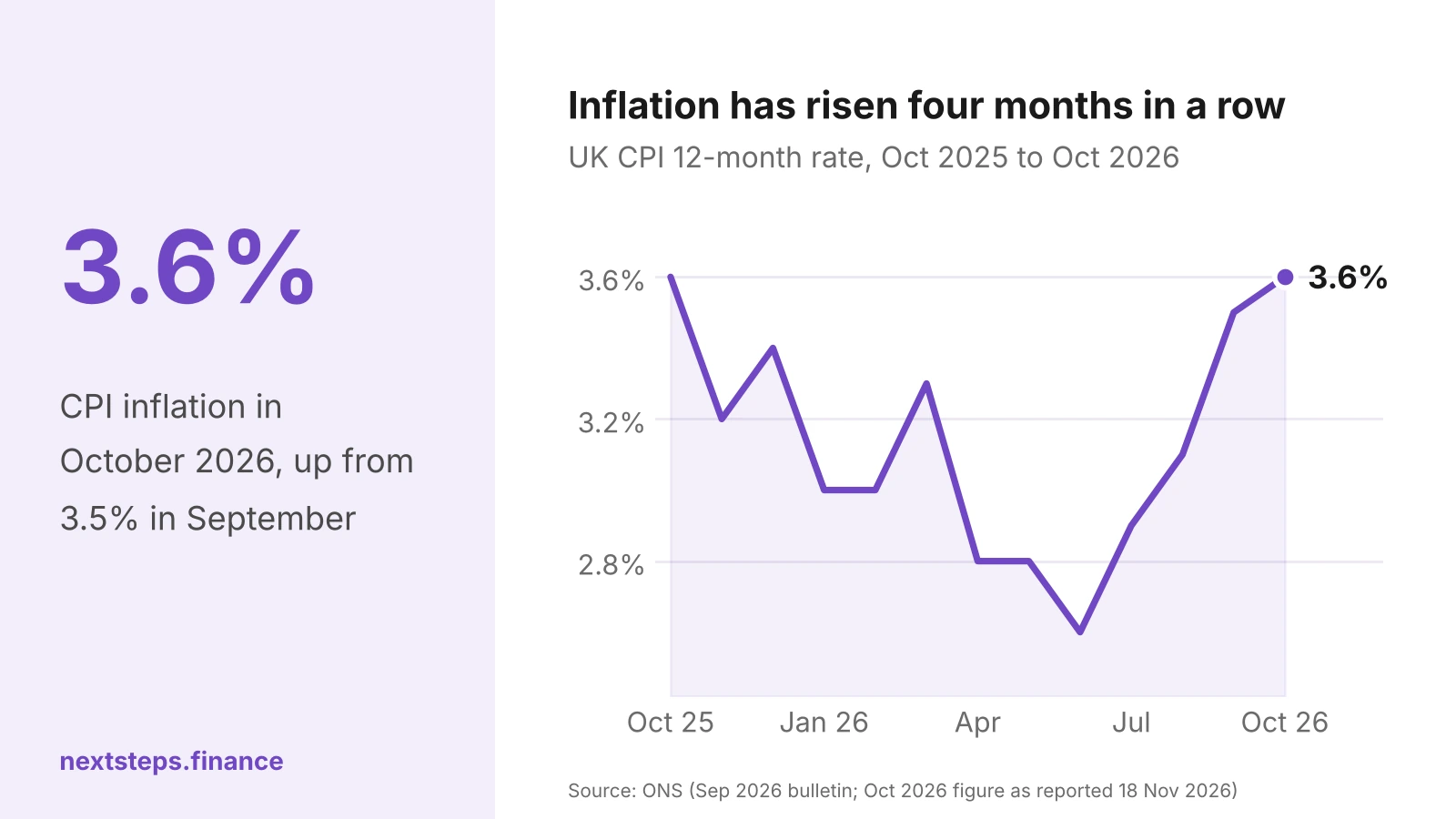
UK inflation in October 2026 rose to 3.6%, its highest rate for a year and the fourth monthly rise in a row. The ONS release published this morning shows fuel doing most of the damage again: diesel hit a record high and petrol climbed to its highest price since 2022. Here's what changed, what it means for your savings, borrowing and bills, and what you can do about it this week.
Stability
UK Inflation October 2026: 3.6% Explained
UK inflation October 2026 rose to 3.6%, a 12-month high driven by record diesel prices. What it means for savings, rates and your budget.
In this article
Key takeaways
- CPI inflation was 3.6% in October 2026, up from 3.5% in September and 2.6% as recently as June.
- Motor fuel prices were 33.2% higher than a year earlier. Diesel rose 7.0p a litre in the month and petrol 5.2p.
- Core inflation held at 2.8% and services at 3.7%, so the rise is mostly energy and tobacco, not the wider economy.
- Bank Rate is 4% after the Bank of England's 5 November rise. Its next decision is on 17 December 2026.
- The average easy access account pays 2.54%, according to Moneyfacts, so most savers are losing money in real terms.
What did the UK inflation October 2026 figures show?
Headline inflation edged up 0.1 points to 3.6%, in line with economists' forecasts. Prices rose 0.5% in the month alone. The other main measures, as reported from the ONS release by PA Media and ActionForex:
| Measure | September 2026 | October 2026 |
|---|---|---|
| CPI (headline inflation) | 3.5% | 3.6% |
| CPIH (includes owner-occupier housing costs) | 3.6% | 3.7% |
| Core CPI (excludes energy, food, alcohol, tobacco) | 2.8% | 2.8% |
| CPI goods | 3.2% | 3.5% |
| CPI services | 3.7% | 3.7% |
| Food and non-alcoholic drinks | 1.3% | 0.9% |
| Motor fuels | 29.8% | 33.2% |
The 3.6% matches October 2025, so inflation is back where it was a year ago after dipping to 2.6% in June. The September figures come from the ONS September bulletin, which we covered in UK inflation hits 3.5%.
Take Action: If your pay rise this year was under 3.6%, your real income has fallen. That's worth knowing before any pay review or job move.
Why is UK inflation rising?
Fuel is the main reason. Transport inflation rose to 7.5%, the largest upward contribution, with motor fuels up 33.2% on the year, the highest rate since July 2022. ONS chief economist Grant Fitzner said fuel prices were "once again a major contributor".
- Diesel rose 7.0p a litre in October to about 199.5p, the highest since records began in 1996 (Investing.com), building on the 192.5p average the ONS recorded in September.
- Petrol rose 5.2p to about 174.7p, its highest since August 2022. A year earlier, petrol rose only 0.7p over the same month.
- Tobacco prices jumped 5.2% in the month after a duty rise on 1 October. Last year the equivalent rise came in late November, so the timing flatters October's increase.
- Restaurants and hotels pulled the other way, with inflation easing to 3.4%.
Food is the one bright spot. Food and soft drink inflation fell to 0.9%, the lowest since September 2021. That helps the weekly shop, but fuel costs usually reach food prices with a delay, so don't assume it lasts.
Is inflation going to keep rising?
Probably. In its November Monetary Policy Summary, the Bank of England said it expects CPI inflation of about 4.5% in early 2027 and around 5% in the second quarter. A big part of that is energy: the price cap for January to March 2027 is announced on 25 November, and supplier forecasts compiled by MoneySavingExpert point to a typical bill of about £2,169 a year, up from £1,723 now. That's a forecast, not a confirmed figure. Our January 2027 energy price cap guide has the detail.
Will the Bank of England raise interest rates again?
It might, but today's figure probably doesn't force its hand. The Bank raised Bank Rate by 0.25 points to 4% on 5 November, with eight of the nine members voting for the rise and Catherine Mann wanting 4.25%. October's 3.6% was in line with expectations, and core inflation didn't move.
The next decision is on Thursday 17 December 2026. The Bank's own forecast of inflation near 5% next spring keeps another rise on the table, especially if the January price cap comes in high. Our interest rate outlook covers what each outcome means for mortgages and savings.
What it means for you:
- Mortgages: tracker and variable rates already reflect the 4% Bank Rate. If your fix ends in the next six months, many lenders let you lock in a new rate early.
- Credit cards and overdrafts: these don't move much with Bank Rate, but higher prices make it easier to slip into borrowing. Clearing expensive debt beats almost any savings rate.
- Savings: rates have risen since the 5 November decision, which is the good news below.
Are your savings beating inflation?
Most aren't. Moneyfacts' latest averages put the average easy access account at 2.54% and the average easy access ISA at 2.76%, both well under 3.6%. Fixed rates do better: the average one-year bond pays 4.51%.
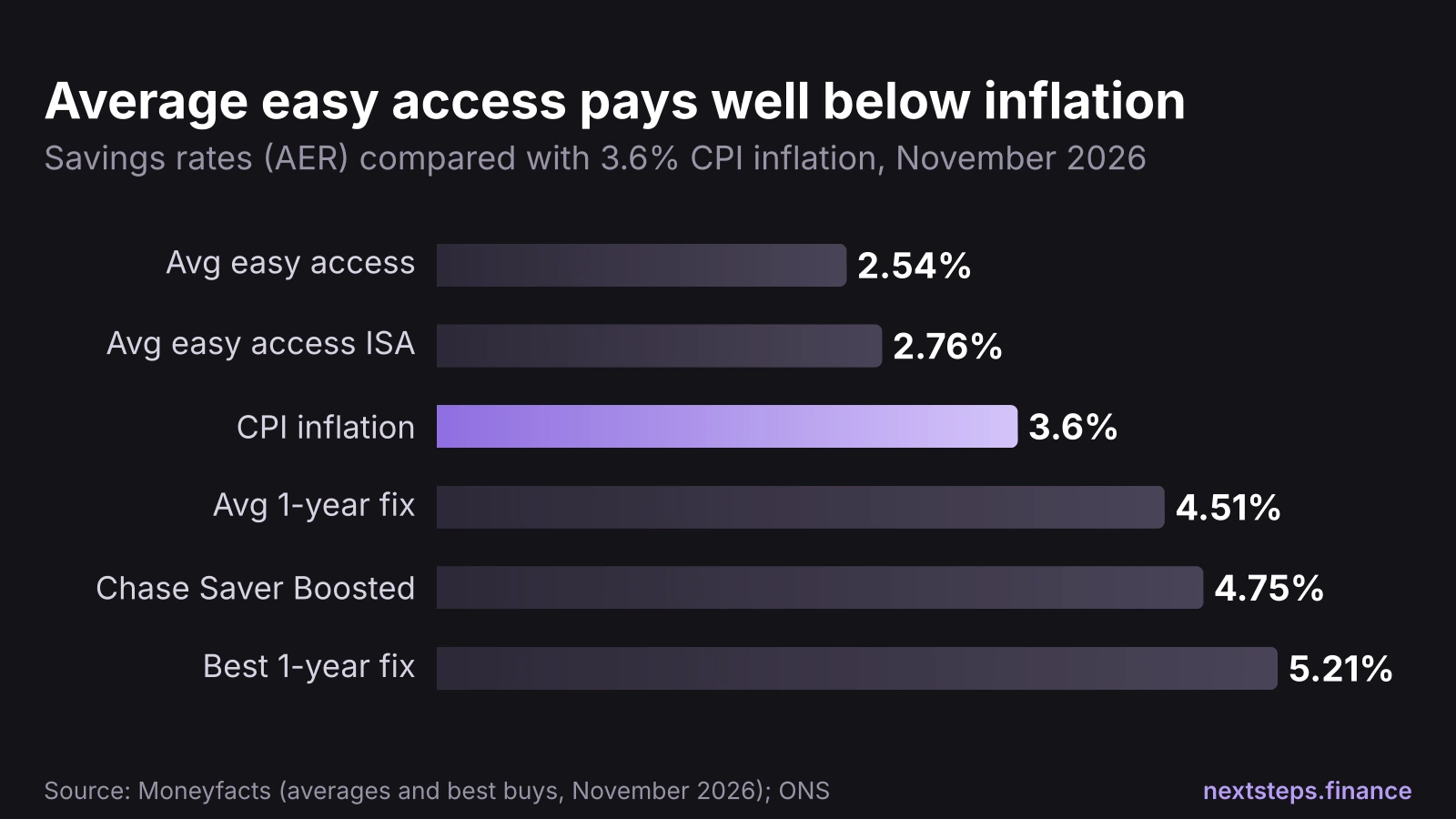
The best accounts on Moneyfacts' tables this week comfortably beat inflation:
| Account type | Top rate (AER) | Provider | Catch |
|---|---|---|---|
| Easy access | 5.00% | LemFi | Includes a 6-month bonus, then drops |
| Easy access | 4.75% | Chase Saver Boosted | New Chase current account customers only |
| Easy access cash ISA | 4.87% | Trading 212 | Includes a 12-month bonus; no transfers in |
| Easy access cash ISA | 4.82% | Plum | Includes a 12-month bonus |
| 1-year fixed bond | 5.21% | Isbank (via Meteor) | £1,000 minimum, money locked in |
| 1-year fixed cash ISA | 5.06% | Kent Reliance | £1,000 minimum |
Rates from Moneyfacts tables updated 16 to 17 November 2026. Rates change often, so check before you apply.
On £10,000, the gap matters. At the 2.54% average you'd earn £254 in a year but lose about £102 in buying power after 3.6% inflation. At 4.75% you'd earn £475 and come out about £111 ahead in real terms.
Try it with your own numbers:
Calculator
How much more could you earn by switching?
- Amount saved£10,000
- Rate A (AER)2.54%
- Rate B (AER)4.75%
- Months12 months
Extra interest with Top easy access£221
Average easy access£254
Top easy access£475
Assumes both rates stay the same for the whole period and you don't withdraw.
Remember tax too. Interest above your Personal Savings Allowance is taxed, which cuts your real return further. A cash ISA avoids that, and our guide to the savings tax changes from April 2027 explains what's changing.
Take Action: Check the rate on your main savings account today. If it's below 3.6%, compare it with our best savings accounts guide.
Should you fix your savings now?
It depends on when you need the money. A one-year fix at 5.21% beats today's inflation by a clear margin, but if inflation reaches the 5% the Bank expects next spring, that margin shrinks. Fixed rates could also rise if the Bank raises rates again in December.
This may suit you if:
- You won't need the money for the full term. Most fixes don't allow withdrawals.
- You already have an emergency fund in easy access. Our emergency fund guide covers how much to keep.
- You'd rather lock in a known return than guess where rates go next.
Splitting your savings is a common middle way: keep a few months' spending in a top easy access account and fix the rest. Our post on fixed savings rates at 5% weighs the timing in more detail.
How can you protect your money from inflation?
For money you won't need for at least five years, investing has historically been the more reliable way to beat inflation, though returns aren't guaranteed and you can lose money. Cash protects you from falls in value but rarely grows much in real terms over long periods.
Low-cost index funds in a stocks and shares ISA are the usual starting point. InvestEngine charges no platform fee on its DIY ETF portfolios, with fund charges from 0.03%, or 0.25% a year for its managed service (InvestEngine costs page, checked 18 November 2026). New customers who join through a referral link and invest £100 or more in an ISA, SIPP or general account get a random welcome bonus of £20 to £200. Most people (75%) get £20 to £24, and you must keep the £100 plus the bonus invested for 12 months (InvestEngine terms, checked 18 November 2026). Capital at risk - the value of investments can go down as well as up.
Our InvestEngine review covers the downsides, including no interest on uninvested cash, and Trading 212 vs InvestEngine compares it with a popular alternative. Vanguard and other large platforms are worth comparing too.
Rebuild your budget for higher prices
Higher fuel costs, a likely jump in energy bills in January and Christmas spending all land at once this winter. The most useful thing you can do is re-run your monthly budget with fuel and energy at their new levels, so January doesn't come as a shock. Our guide to protecting your budget from 5% inflation has practical ways to cut costs.
If you'd rather not build a budget from scratch:
FAQ
What is the UK inflation rate for October 2026?
UK CPI inflation was 3.6% in the 12 months to October 2026, up from 3.5% in September, according to the Office for National Statistics on 18 November 2026. CPIH, which includes housing costs, was 3.7%. Core inflation, which strips out energy, food, alcohol and tobacco, stayed at 2.8%.
Why has UK inflation gone up?
Motor fuels were the main cause. Fuel prices were 33.2% higher than a year earlier, with diesel at a record high of about 199.5p a litre. A tobacco duty rise on 1 October also pushed prices up. Falling inflation in restaurants and hotels, and food inflation of just 0.9%, partly offset the rise.
When is the next UK inflation figure?
The ONS normally publishes CPI inflation on a Wednesday around the middle of each month. The November 2026 figure is expected in mid-December, shortly before the Bank of England's interest rate decision on 17 December 2026. Check the ONS release calendar for the confirmed date.
Will interest rates go up in December 2026?
It isn't certain. The Bank of England raised Bank Rate to 4% on 5 November 2026 and expects inflation to reach around 5% in spring 2027, which keeps another rise possible. October's 3.6% was in line with forecasts, so the January energy price cap and wage data may matter more.
Is my savings account beating inflation?
Only if it pays more than 3.6% after tax. Moneyfacts puts the average easy access rate at 2.54%, which loses about £102 a year in buying power on £10,000. Top easy access accounts pay around 4.75% and one-year fixes up to 5.21%, both above inflation.
The bottom line
Inflation at 3.6% isn't a shock, but the direction is clear: the Bank of England expects about 5% by next spring, and energy bills are likely to rise in January. Move cash out of accounts paying less than inflation, consider fixing money you won't need for a year, and for long-term money look at low-cost investing through a platform such as InvestEngine (capital at risk). Most of all, update your budget now with our UK Budget Planner so January's bills don't catch you out.
Found this useful? Add Next Steps Finance as a preferred source and Google will show you more of our guides in search and AI answers.