
How much should I save each month in the UK? There isn't one right figure, but there is a sensible range: 10% of take-home pay is a solid start, 15% is comfortable and 20% is the target the 50/30/20 rule sets. This guide turns those percentages into pounds for real 2026/27 salaries, shows what to save for first, and where the money can earn the most while you build it.
Foundations
How Much Should I Save Each Month UK?
How much should I save each month in the UK? A guide by salary for 2026/27, with real take-home figures, a simple order of priorities and where to keep it.
In this article
Key takeaways
- The rule of thumb: save 10-20% of take-home pay each month, not of your gross salary. Your workplace pension is extra.
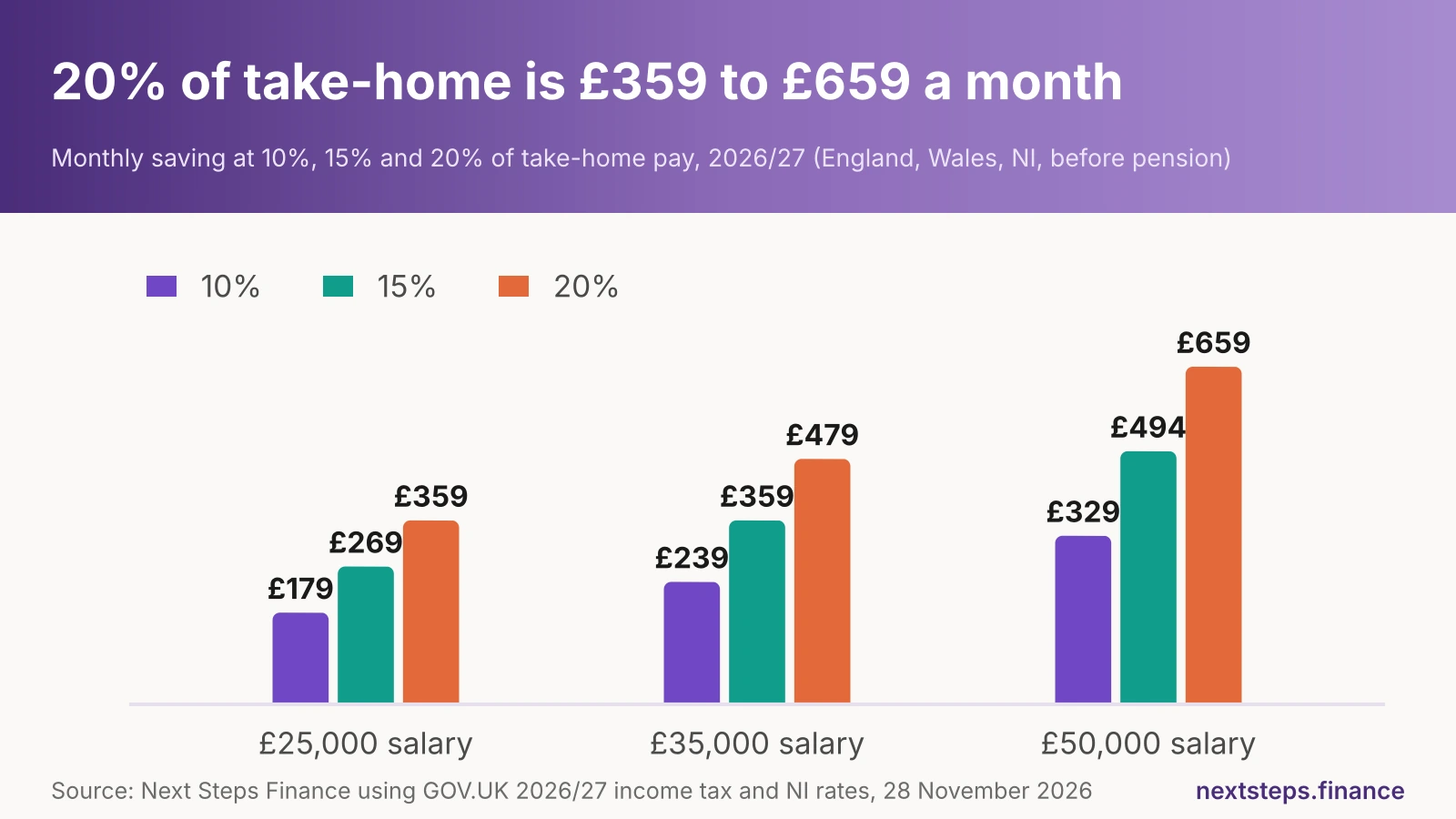
- In pounds: 20% of take-home is about £359 a month on £25,000, £479 on £35,000 and £659 on £50,000 in England, Wales and Northern Ireland in 2026/27, before pension.
- Your pension already saves for you: the legal minimum is 8% of qualifying earnings (5% from you, 3% from your employer) on pay between £6,240 and £50,270, says GOV.UK.
- UK households saved 8.8% of their disposable income in April to June 2026, according to the ONS.
- Order matters: emergency fund first, then expensive debt, then goals such as a house deposit, an ISA or extra pension.
The quickest way to find your own number is to build a budget and see what's genuinely left. The UK Budget Planner does that from your real take-home pay and tracks your savings month by month.
How much should I save each month in the UK?
Most UK guidance lands on 10% to 20% of what reaches your bank account. The 20% figure comes from the 50/30/20 rule: 50% for needs, 30% for wants and 20% for savings and paying off debt faster.
Percentages of take-home pay work better than a fixed amount because they grow with your pay. They also keep the target realistic: someone on £25,000 who rents alone may manage 10%, while a couple sharing the rent may manage 25% or more.
| Saving rate | What it means | Who it may suit |
|---|---|---|
| 5% | A starting habit | High rent, a new job, or paying off debt |
| 10% | Solid baseline | Most single earners |
| 15% | Comfortable | Building towards a goal in 2-3 years |
| 20%+ | Strong | Couples sharing costs, higher earners, or a deposit deadline |
For context, the ONS says the UK household saving ratio was 8.8% in April to June 2026. That figure includes some pension saving, so if you're putting away 10% of take-home pay on top of your workplace pension, you're doing better than the national average.
Take Action: Pick a starting rate you can keep up for a year. You can raise it later; giving up after two months helps nobody.
How much should I save on my salary?
Start from your take-home pay. For 2026/27, GOV.UK confirms a £12,570 Personal Allowance and 20% basic rate up to £50,270, and employees pay 8% National Insurance on earnings in the same band (GOV.UK). Here's what that leaves, and what each saving rate means in pounds.
| Salary | Take-home a month (before pension) | Save 10% | Save 15% | Save 20% |
|---|---|---|---|---|
| £25,000 | £1,793 | £179 | £269 | £359 |
| £35,000 | £2,393 | £239 | £359 | £479 |
| £50,000 | £3,293 | £329 | £494 | £659 |
These figures are for England, Wales and Northern Ireland, with a standard 1257L tax code and no student loan. A workplace pension taken from your pay lowers take-home a little, but it's saving too, so count it separately.
For full worked budgets at these salaries, see how to budget on £25,000 and £50,000. Our UK budget calculator splits your own take-home pay into needs, wants and savings.
Does my pension count as saving?
Yes. Your workplace pension is long-term saving, so you don't need to fund retirement from the 10-20% as well. Under auto-enrolment, GOV.UK sets a minimum of 8% of earnings between £6,240 and £50,270: at least 3% from your employer and the rest from you, including tax relief.
On a £35,000 salary that works out at roughly:
- You: about £120 a month (5% of £28,760 qualifying earnings), costing you around £96 after basic-rate tax relief
- Your employer: about £72 a month
- Total: about £192 a month going into your pension
That's why the savings figures above are on top of your pension. The minimum may not be enough for a comfortable retirement, so once your emergency fund is in place, raising your pension contribution is often worth a look, especially if your employer matches extra. Our guide to employer pensions explains matching and salary sacrifice.
Take Action: Check your payslip for your pension percentage and whether your employer pays more if you do.
What should I save for first?
Save for an emergency fund first, then clear expensive debt, then save for goals. Doing it in this order means a broken boiler or a gap between jobs doesn't end up on a credit card.
- Starter emergency fund. Aim for £1,000 or one month of essential costs, whichever is easier to reach.
- Expensive debt. Credit cards and overdrafts usually charge far more than any savings account pays, so overpaying them is often the best "return" you can get.
- Full emergency fund. The usual rule of thumb is three to six months of essential costs. Our emergency fund guide shows how to work out your number.
- Known costs. Car repairs, Christmas, holidays and annual bills. Sinking funds spread these into monthly amounts.
- Bigger goals. A house deposit, extra pension, or investing in an ISA. The ISA allowance is £20,000 a year (GOV.UK).
A worked example: a single renter on £35,000 with £1,600 a month of essential costs needs £4,800 for three months of cover. Saving 15% (£359 a month), that takes about 13-14 months, before interest.
If you'd rather not track this on a spreadsheet, the planner does it for you:
Where should I keep my monthly savings?
Keep your emergency fund and short-term savings in an easy access account, ideally one paying more than inflation. After the Bank of England raised Bank Rate to 4% in November 2026, and with the Bank's November Monetary Policy Report expecting inflation to rise to around 5% by mid-2027, the rate you earn matters more than usual.
Top easy access rates listed by Moneyfacts on 27 November 2026, alongside the two apps we partner with:
| Account | Rate (AER variable) | Key condition |
|---|---|---|
| Plum Easy Access | 5.25% on the first £1,000, then 3.15%-3.90% by plan | New Plum customers who open it within 30 days of registering |
| Chase Saver | 4.75% including a 12-month bonus | Chase current account customers only |
| Chip Everyday Savings | 4.57% including a 12-month bonus | New customers |
| Zopa Limited Access pot | 4.56% including a 12-month bonus | Three free withdrawals a year |
| Revolut Instant Access Savings | 2.90% Standard to 4.00% Ultra | Rate depends on your Revolut plan |
Plum is built around the monthly habit: it can move money into savings automatically, and its Easy Access page says the money is held with Lloyds Bank and protected by the FSCS up to £120,000 (that limit covers all your Lloyds deposits combined). The 5.25% rate only applies to the first £1,000, so it suits someone starting an emergency fund more than someone moving a large balance. Above that, the Basic plan pays 3.15%, and the paid plans (£3.99 to £14.99 a month) pay more.
Revolut pays from 2.90% on the Standard plan up to 4.00% on Ultra, according to its savings terms, with savings held at ClearBank and FSCS protected up to £120,000. It may suit you if you already use Revolut for spending, though the higher rates come with monthly plan fees.
Don't overlook your own bank or a building society, and compare the current list in our best savings accounts guide before choosing.
Try it with your own numbers:
Calculator
How much could your monthly savings grow to?
- Starting balance£0
- Monthly saving£359
- Interest rate (AER)4.57%
- Years3 yrs
Balance after 3 years£13,805
You pay in£12,924
Interest earned£881
Assumes the rate stays the same and interest is added monthly. Variable rates can change, and interest above your Personal Savings Allowance may be taxable outside an ISA.
How do I actually stick to it?
Pay yourself first: move your savings on payday, before you start spending. People who save what's left at the end of the month usually find there's nothing left.
- Automate it. Set a standing order for the day after payday, or let an app such as Plum move money for you.
- Separate it. Keep savings out of your current account so they don't get spent by accident.
- Name the pot. "Emergency fund" or "House deposit" is harder to raid than "Savings".
- Raise it with pay rises. Put half of any pay rise into savings before you get used to it.
- Review in January. A new year is a natural point to check your rate against your budget.
Zero-based budgeting works well here, because savings get their job on day one instead of at the end. Our complete guide to budgeting in the UK covers the other methods.
Take Action: Set up one standing order today, even if it's £50. Then increase it once your budget shows room.
What if I can't afford to save 10%?
Save what you can, even £20 or £50 a month. The habit matters more than the amount at first, and a small buffer stops a minor bill becoming debt.
If your essentials take up most of your pay, start by checking your costs line by line: energy tariff, phone and broadband contracts, insurance renewals and subscriptions often free up £50 to £100 a month. If you're struggling with debt, free help is available from StepChange and Citizens Advice. Paying down a 25%+ credit card first can do more for you than saving at 4%.
Bottom line
A good target is 10% to 20% of take-home pay, on top of your workplace pension. In 2026/27 that's £179 to £359 a month on £25,000 and £329 to £659 on £50,000. Build an emergency fund first, keep it in a decent easy access account, and automate the transfer on payday. The UK Budget Planner helps you find your number and stick to it, and our free budget template is a simpler starting point.
FAQ
How much should I save each month in the UK?
Aim to save 10% to 20% of your take-home pay each month, plus your workplace pension. In 2026/27 that's about £239 to £479 a month on a £35,000 salary in England, Wales and Northern Ireland. If that's too much, start with 5% and raise it when your pay rises or a debt is cleared.
Is saving £500 a month good in the UK?
Yes, £500 a month is a strong amount for most UK earners. It's about 21% of the £2,393 monthly take-home on a £35,000 salary in 2026/27, above the 20% target of the 50/30/20 rule. Over a year it adds up to £6,000 before interest, enough for a solid emergency fund for many people.
How much should I have saved by 30 in the UK?
There's no official UK benchmark. A practical aim by 30 is a full emergency fund of three to six months' essential costs, no expensive debt and a workplace pension you've paid into since you started work. After that, goals such as a house deposit depend on your income, housing costs and plans.
What is the 50/30/20 rule for saving?
The 50/30/20 rule splits take-home pay into 50% for needs, 30% for wants and 20% for savings and extra debt repayments. On a £25,000 salary in 2026/27, 20% is about £359 a month. In high-rent areas a 70/10/20 or 60/20/20 split is often more realistic.
Should I save or pay off debt first?
Build a small emergency fund of around £1,000 first, then pay off expensive debt such as credit cards and overdrafts before saving more. Card interest is usually far higher than any savings rate. Cheap or 0% debt is different: keep paying it on time while you build savings.
Found this useful? Add Next Steps Finance as a preferred source and Google will show you more of our guides in search and AI answers.
Put this into practice
Build your budget in one sitting
The UK Budget Planner works out your take-home pay, splits it with the 50/30/20 rule, tracks spending through the year and forecasts five years ahead. Made for UK pay, tax and bills.