A payslip does one job for employees that you have to do yourself: turn lumpy income into a steady amount you can live on. This self employed budget UK guide shows how to work out what to set aside for tax using GOV.UK's 2026/27 rates, how to pay yourself a fixed "salary" from a buffer, and how to avoid the payments on account shock that catches many sole traders in their second January.
Foundations
Self Employed Budget UK: Irregular Income
Self employed budget UK guide: set aside tax, pay yourself a fixed monthly wage from a buffer and plan for payments on account, with 2026/27 figures.
In this article
- 01Key takeaways
- 02Why is budgeting harder when you're self-employed?
- 03How much should I set aside for tax when self-employed?
- 04How do I budget with irregular income?
- 05How do I work out what to pay myself?
- 06What are payments on account and how do they affect my budget?
- 07Where should I keep my tax pot and buffer?
- 08How big should a self-employed emergency fund be?
- 09What else should a self-employed budget include?
- 10FAQ
Key takeaways
- Income tax and Class 4 NI take about 17% of a £36,000 profit in 2026/27 (£6,092), rising to about 19.5% at £50,000 and 23% at £60,000 in England, Wales and Northern Ireland.
- Class 4 National Insurance is 6% on profits between £12,570 and £50,270 and 2% above that, according to GOV.UK.
- Your first payments on account can make one January bill 50% bigger: each payment is half of last year's tax, due 31 January and 31 July.
- Making Tax Digital reaches sole traders and landlords with qualifying income over £30,000 from 6 April 2027, so quarterly updates become a natural budget check-in.
- A buffer of about one month's pay would have covered every shortfall in our 12-month worked example below.
If you'd like a ready-made sheet for the monthly plan, the UK Budget Planner does the sums for you.
Why is budgeting harder when you're self-employed?
Budgeting is harder when you're self-employed because your income arrives at different times and in different amounts, and nobody takes your tax off before you get paid. An employee's budget starts from a known take-home figure. Yours has to create one.
Three things trip people up most:
- The money in your account isn't all yours. Part of every invoice belongs to HMRC, but it isn't due until 31 January after the tax year ends, up to 22 months later.
- Good months feel like pay rises. If you spend to match income, a quiet month means borrowing or missing bills.
- There's no employer behind you. No sick pay beyond what you've saved, no employer pension contribution and no paid holiday, so these all need their own lines in your budget.
The fix is the same idea as a payslip: separate the money that comes in from the money you live on, and put a fixed amount between them.
How much should I set aside for tax when self-employed?
Most sole traders in England, Wales and Northern Ireland need to set aside somewhere between 10% and 23% of profit for income tax and National Insurance, depending on how much they make. Work it out from profit (income minus allowable expenses), not from turnover.
For 2026/27, GOV.UK's income tax rates page gives a Personal Allowance of £12,570, 20% basic rate on £12,571 to £50,270 and 40% higher rate on £50,271 to £125,140. On top of that, Class 4 National Insurance is 6% on profits from £12,570 to £50,270 and 2% above. If your profits are £7,105 or more, GOV.UK says Class 2 contributions are treated as paid, so you don't pay them but your NI record is protected.
| Annual profit (2026/27) | Income tax | Class 4 NI | Total | % of profit | Set aside a month |
|---|---|---|---|---|---|
| £20,000 | £1,486 | £446 | £1,932 | 9.7% | £161 |
| £30,000 | £3,486 | £1,046 | £4,532 | 15.1% | £378 |
| £36,000 | £4,686 | £1,406 | £6,092 | 16.9% | £508 |
| £40,000 | £5,486 | £1,646 | £7,132 | 17.8% | £594 |
| £50,000 | £7,486 | £2,246 | £9,732 | 19.5% | £811 |
| £60,000 | £11,432 | £2,457 | £13,889 | 23.1% | £1,157 |
These figures assume self-employment is your only income and you get the standard Personal Allowance. Scotland has different income tax bands, and student loan repayments, other income or pension contributions change the numbers. If you also have a job, our guide to side hustle tax when employed shows how the two interact.
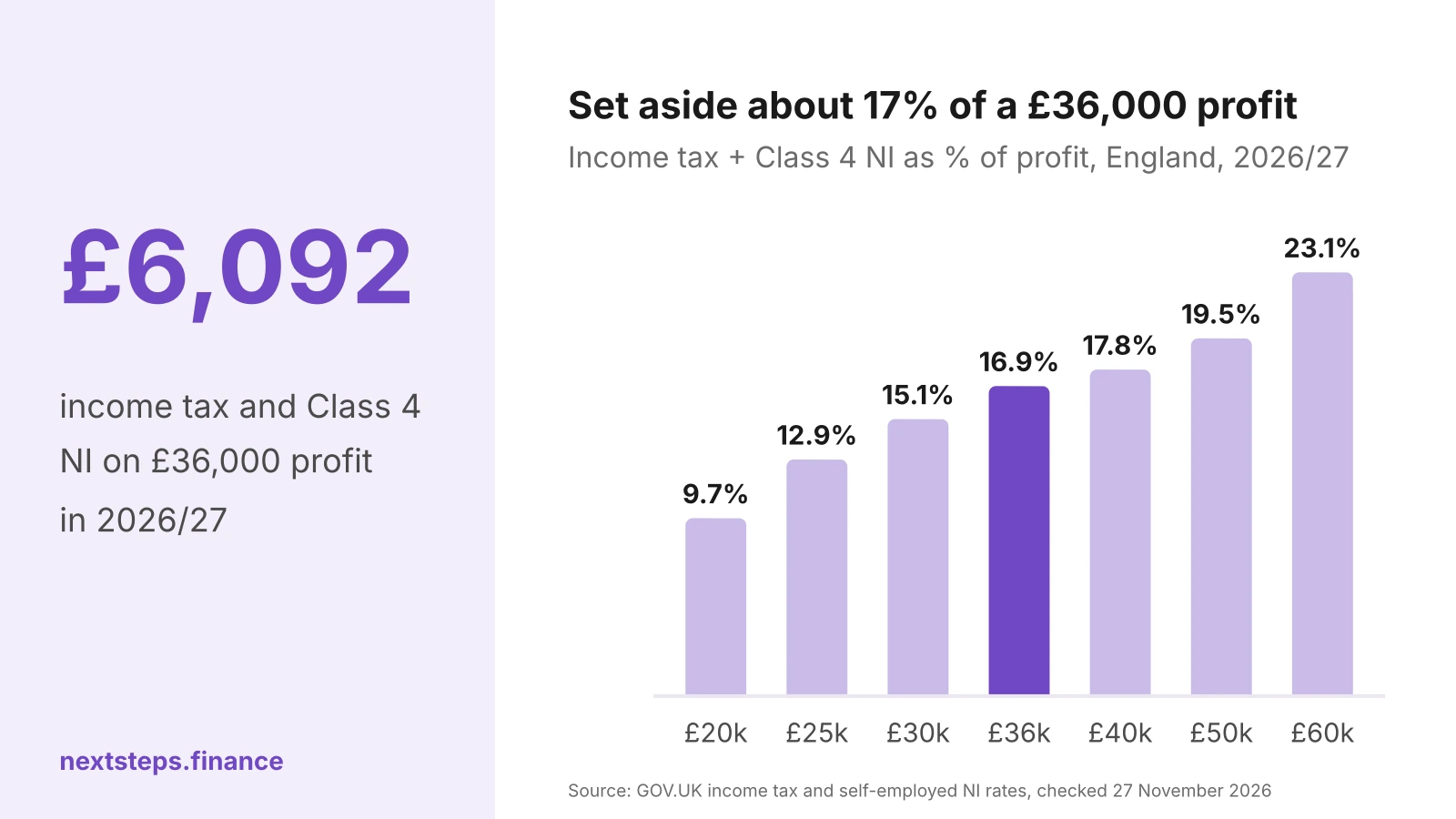
A simple habit is to round up: if the table says 17%, move 20% of every payment into a separate tax pot the day it lands. Anything left over after your tax bill is paid is a bonus, not a debt.
Take Action: Find your profit band in the table and set up an automatic transfer or a separate savings pot for that percentage.
How do I budget with irregular income?
You budget with irregular income by paying yourself a fixed monthly amount from a holding account, and letting that account absorb the ups and downs. Your personal budget then runs on a steady number, just like an employee's.
The system uses four places for your money:
| Account | What goes in | What comes out |
|---|---|---|
| Business or income account | Every client payment | Business costs, then transfers to the other three |
| Tax pot | Your set-aside percentage of every payment | Your Self Assessment bill in January and July |
| Buffer | Whatever's left after tax and costs | One fixed "pay" transfer a month |
| Personal current account | Your fixed pay | Rent, bills, food and everything else in your budget |
Here's the order each month:
- When a payment arrives, move your tax percentage to the tax pot straight away.
- Pay business costs from the income account.
- Sweep the rest into the buffer.
- On the same date every month, transfer your fixed pay from the buffer to your personal account.
- Once the buffer is above your target, send the surplus to savings, a pension or debt.
A personal budget built on that fixed pay can follow any method you like. Zero-based budgeting suits this well, because you're giving a known amount a job each month.
How do I work out what to pay myself?
Pay yourself what your last 12 months of profit can support after tax, divided by 12, then round down. If you're newer than that, start from your essential costs and only raise your pay once the buffer has built up.
In our worked example, a sole trader makes £36,000 profit in 2026/27. After £6,092 of income tax and Class 4 NI, that leaves £29,908 a year, or about £2,492 a month. They pay themselves £2,490.
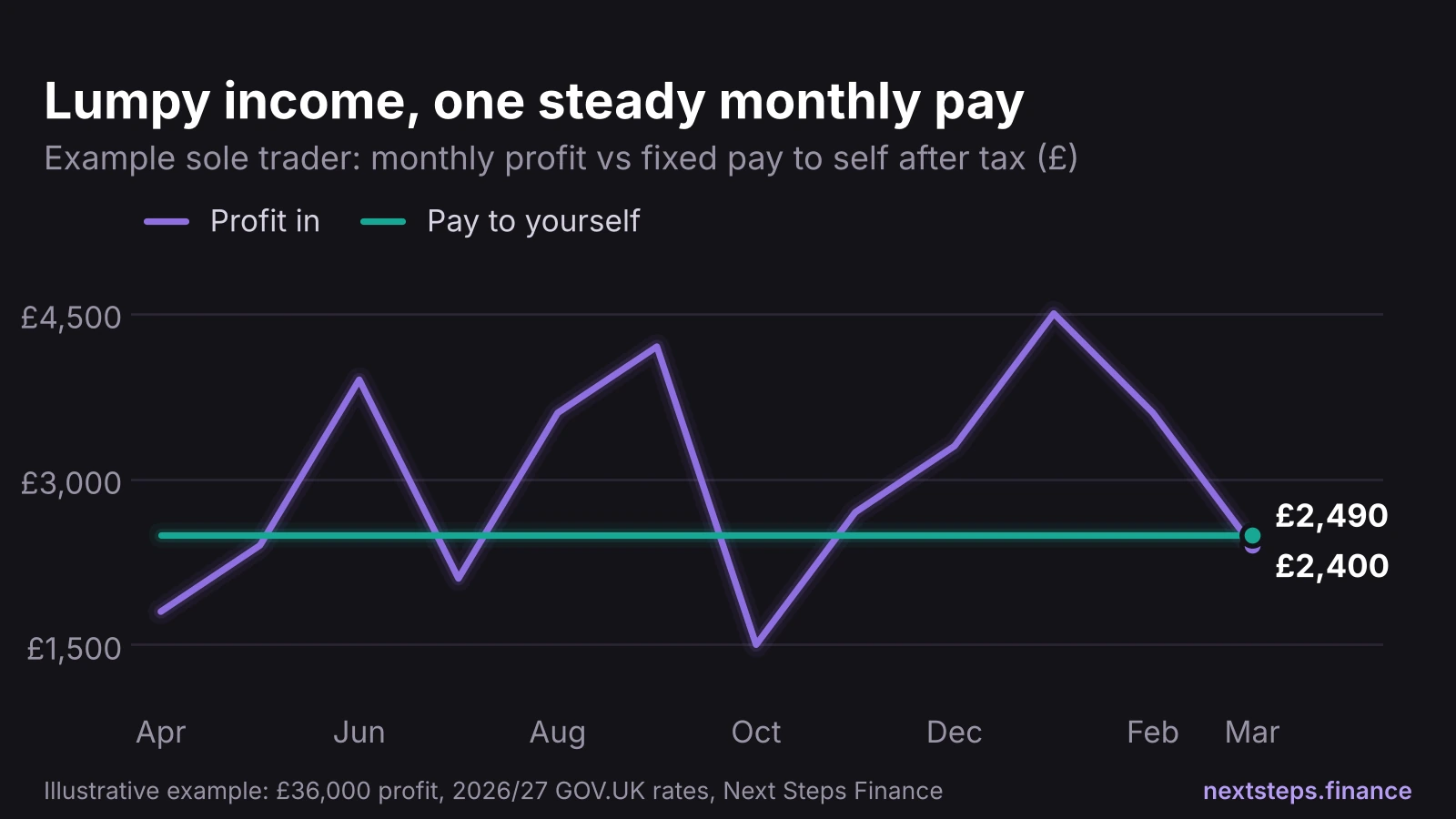
Their profit swings from £1,500 in October to £4,500 in January. Paying themselves whatever came in would mean a £1,500 month followed by a £4,500 one. With the buffer, they get £2,490 every month. Our sums show the buffer would have dropped to about £1,490 below zero at its lowest point, after a slow April and May, so starting with one month's pay (about £2,500) in the buffer would have covered every gap.
If your income is very seasonal, base your pay on your quietest months, not the average, and take a top-up from the buffer once or twice a year when it's clearly ahead.
What about the essential costs budget?
Before you set your pay, write a bare-bones budget: rent or mortgage, council tax, energy, food, transport, insurance and minimum debt payments. That's the lowest figure you can live on for a few months if work dries up. Our UK budget calculator is a quick way to total it, or download the free UK budget template.
If you'd rather track the buffer, tax pot and fixed pay in one sheet:
What are payments on account and how do they affect my budget?
Payments on account are advance payments towards next year's tax bill, and they're the biggest budgeting trap for newer sole traders. GOV.UK says each payment is half of the tax you owed last year, due by 31 January and 31 July, and they include Class 4 NI.
You don't have to make them if last year's tax bill was under £1,000, or if more than 80% of your tax was already paid outside Self Assessment, for example through your tax code.
The shock comes in the first January they apply. Using our £36,000 example, and assuming no payments on account were due before:
| Due date | What's due | Amount |
|---|---|---|
| 31 January 2028 | Full 2026/27 bill | £6,092 |
| 31 January 2028 | First payment on account for 2027/28 | £3,046 |
| 31 January 2028 total | £9,138 | |
| 31 July 2028 | Second payment on account for 2027/28 | £3,046 |
So one January bill is 50% bigger than the tax on the year's profit. If you set aside 20% from the start of the tax year, rather than 17%, the extra 3% goes a long way towards that first payment on account. Our guide to payments on account for sole traders explains how to ask HMRC to reduce them if your profit is falling. This January's deadline and what's due are covered in our Self Assessment deadline guide.
Is this changing?
Yes, but not yet. HMRC's timely payments factsheet, published on 28 October 2026, says that from April 2029 people who make payments on account will make smaller, more regular payments, likely automated by Direct Debit. The total you owe doesn't change, only when you pay it. Until then, the 31 January and 31 July dates stand.
Where should I keep my tax pot and buffer?
Keep your tax pot and buffer in an easy access savings account that's separate from your spending account, so the money earns interest but you can't spend it by accident. You need easy access because tax bills and slow months don't wait for a notice period.
Plum is one option. Its Easy Access account, checked on 27 November 2026, pays 5.25% AER variable on the first £1,000 for new Plum customers who open it within 30 days of registering. Above £1,000, it pays 3.15% AER variable on the free Basic plan, rising to 3.90% on Max at £14.99 a month. The account is provided by Lloyds Bank, and Plum says deposits are protected by the FSCS up to £120,000, counted together with anything else you hold with Lloyds.
The downsides: the 5.25% only applies to the first £1,000, Plum doesn't state how long the promotional rate lasts, and the paid plans cost more than the extra interest unless your balance is large. Money sitting in Plum's main pocket rather than the savings account is e-money, which the FSCS doesn't cover. Our Plum review goes into the plans in more detail.
Non-affiliate alternatives work just as well: a second easy access account with your own bank, a savings pot in a bank app or NS&I Direct Saver. Compare rates and pick whatever you'll actually leave alone.
Try it with your own numbers:
Calculator
How much interest could your tax pot earn in a year?
- Starting balance£0
- Monthly tax set-aside£508
- Interest rate (AER)3.15%
- Years1 yrs
Balance after 1 year£6,184
You pay in£6,096
Interest earned£88
Defaults use the £508 a month set-aside for £36,000 profit and Plum's 3.15% AER variable Basic rate above £1,000, checked 27 November 2026. Rates can change.
How big should a self-employed emergency fund be?
A self-employed emergency fund usually needs to be bigger than an employee's, because there's no sick pay or notice period to fall back on. Many people aim for three to six months of essential costs, on top of the working buffer and kept apart from the tax pot.
Think of it in layers:
- Tax pot: never touched for anything else.
- Working buffer: about one month's pay, which smooths normal ups and downs.
- Emergency fund: three to six months of your bare-bones budget, for illness, a lost client or a broken laptop.
Build them in that order. Our emergency fund guide covers where to keep it and how to build it faster.
What else should a self-employed budget include?
A self-employed budget should also cover the things an employer would normally handle: pension, time off, equipment and irregular costs. Leave them out and the budget only works in a perfect month.
- Pension: there's no employer contribution, so any pension saving comes from you. Contributions to a personal pension get tax relief.
- Holidays and quiet weeks: if you don't work, you don't earn. Divide your pay by fewer working weeks, or save for time off monthly.
- Equipment and software: laptop replacements, subscriptions and insurance renewals. Sinking funds turn these yearly costs into small monthly amounts.
- Making Tax Digital: GOV.UK says sole traders and landlords with qualifying income over £50,000 started from 6 April 2026, over £30,000 join from 6 April 2027, and over £20,000 from 6 April 2028. HMRC estimates around 1,077,000 more people will join in April 2027. Budget for compatible software if you'll need it, and use each quarterly update to check your tax pot is on track.
- The trading allowance: it's £1,000 now, and LITRG's Budget summary reports it rising to £3,000 from 6 April 2027, which mainly helps people with small side incomes.
For the wider picture of how this fits into your finances, see our complete guide to budgeting in the UK, and use the UK Budget Planner to run your fixed monthly pay, bills and sinking funds in one place. If you'd like a qualified second opinion on your set-up, our personal finance review looks at your numbers in full.
FAQ
How do I budget if I'm self-employed?
Budget by paying yourself a fixed monthly amount from a buffer account, rather than spending what comes in each month. Move a set percentage of every payment into a tax pot, pay business costs, sweep the rest into the buffer and transfer the same "pay" to your personal account each month. Then budget that fixed figure like a salary.
What percentage should I save for tax when self-employed?
In England, Wales and Northern Ireland, income tax and Class 4 NI take about 9.7% of a £20,000 profit, 16.9% of £36,000 and 19.5% of £50,000 in 2026/27. Many sole traders round up to 20% to 25%, which also helps cover the first payment on account. Scotland's income tax bands differ.
How much should a self-employed person have in savings?
Aim for three separate amounts: your tax pot for the next bill, a working buffer of about one month's pay to smooth irregular income, and an emergency fund of three to six months of essential costs. The emergency fund usually needs to be bigger than an employee's because there's no sick pay.
When do I pay tax if I'm self-employed?
Self Assessment tax is due by 31 January after the tax year ends, so tax on 2026/27 profits is due by 31 January 2028. If your bill is £1,000 or more, you'll usually also make payments on account towards the next year, each half of last year's bill, due 31 January and 31 July.
How do I pay myself as a sole trader?
As a sole trader you pay yourself by transferring money from your business or income account to your personal account. These transfers, called drawings, aren't taxed themselves: tax is worked out on your profit. A fixed monthly transfer, set at what your after-tax profit supports, makes your personal budget much easier to run.
Found this useful? Add Next Steps Finance as a preferred source and Google will show you more of our guides in search and AI answers.
Put this into practice
Build your budget in one sitting
The UK Budget Planner works out your take-home pay, splits it with the 50/30/20 rule, tracks spending through the year and forecasts five years ahead. Made for UK pay, tax and bills.